
 al28894
I seem to be making up in my dearth of presence over the week by wanting to post here almost every day. So many things have happened in the past few days that I feel should be noted for posterity.
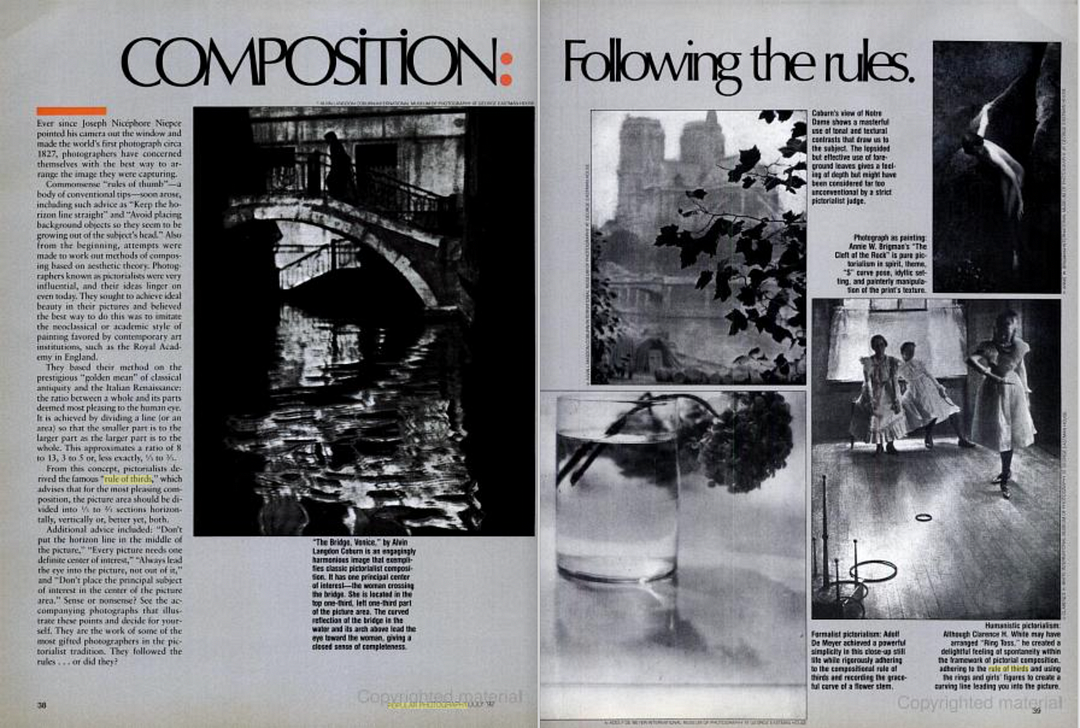
Case in point: this article about the Rule of Thirds.
Now, I have known for a long while that the Rule of Thirds isn't a divine commandment - Indian, Islamicate, and Chinese art have not used the concept yet all three have created beautiful works across the millenias. That said, I did not know the Rule of Thirds is relatively recent. Prior to the 1900s, the rule practically did not exist!
Similarly, a lot of people today think of another concept: the Golden Mean / Rule / Ratio / Whatever. Somehow, this is now seen as a sublime universal concept that is found in almost all global art. But I can definitely say a lot of Indian temples, Islamic miniatures, kampung houses, or Mesoamerican temples do not subscribe to that view.
This article finally explains how do these two rules came to dominate the artistic scene, and why so many people confuse them for each other or even mash them together. In short: they were suggestions and misattributions that grew waaaay out of hand, passed around in a broken game of telephone, popularized by camera manufacturers, and then accepted as 'common knowledge'.
Also, Carlton Wallace. Oh my god, Carlton Wallace. Truly a person who is a know-nothing know-it-all. You make pocket books for gardening, motor cycling, and house doctors?
Though the subject is a bit dry in places, I find it deeply interesting to read as a person who dabbles a bit in art (look at this blog, for example). I shall close this entry by quoting a famous photograher, Henri Cartier-Bresson, and how he feels about the Golden Rule in 1952:
In applying the Golden Rule, the only pair of compasses at the photographer’s disposal is his own pair of eyes. Any geometrical analysis, any reducing of the picture to a schema, can be done only (because of its very nature) after the photograph has been taken, developed, and printed — and then it can be used only for a postmortem examination of the picture. I hope we will never see the day when photo shops sell little schema grills to clamp onto our viewfinders; and the Golden Rule will never be found etched on our ground glass. [emphasis added]
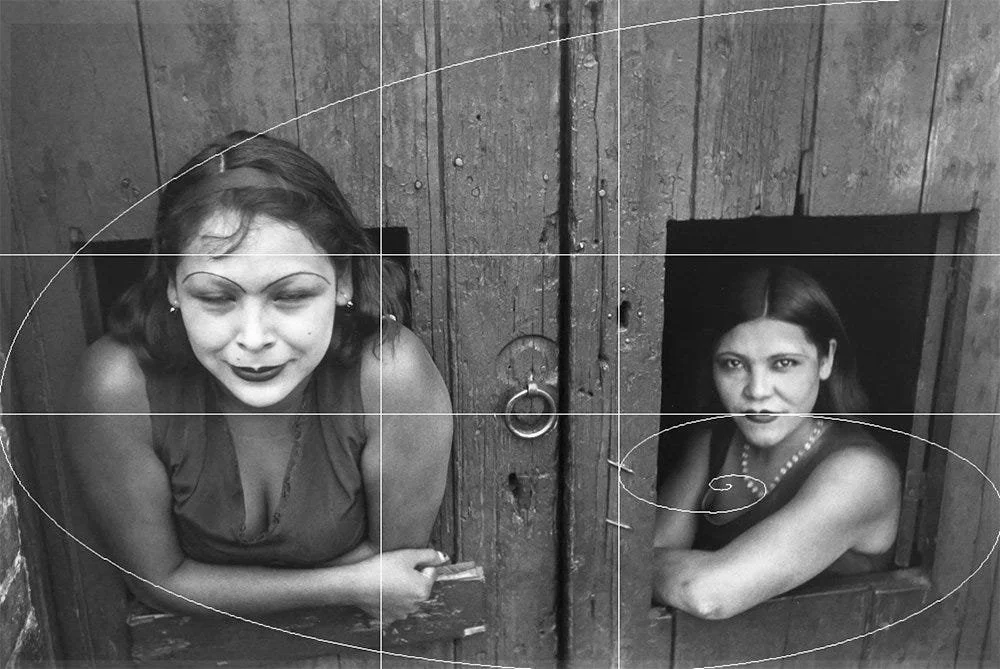
This photo of two women follows the rules of photography! Ignore how the middle-thirds are out-of-proportion and the Golden Ratio spiral is very much squished!
Source: Calle Cuauhtemoctzin, Mexico City by Henri Cartier-Bresson, 1934


